
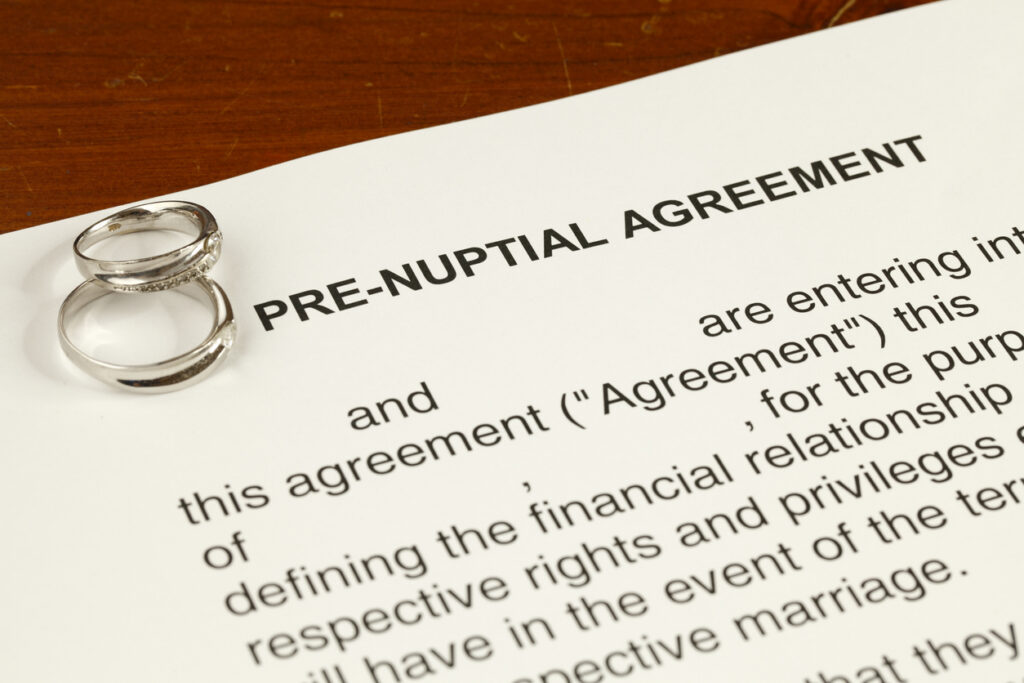
A prenuptial agreement is a legal contract signed by both parties before marriage that addresses financial and legal issues that may arise in the event of divorce or death. While some people view prenuptial agreements as unromantic, they are often one of the most practical and protective steps a couple can take before entering into marriage.
A properly drafted prenuptial agreement can address a wide range of issues, including spousal support (alimony), the division of marital assets, ownership of businesses, retirement accounts, bank accounts, investments, and real estate acquired during the marriage. It can also define the rights of a surviving spouse in the event one spouse dies during the marriage.
Under New Jersey law, a surviving spouse may have the right to claim approximately one-third of the deceased spouse’s estate through what is known as an “elective share.” A prenuptial agreement can waive or limit that right. In some situations, the agreement may instead provide for life insurance benefits, a specific inheritance amount, or another agreed-upon financial arrangement. Some agreements even include substantial gifts that become effective upon marriage.
Why Prenuptial Agreements Make Sense
After years of litigating financial disputes between spouses, one reality becomes clear: divorce litigation can be emotionally exhausting, financially draining, and extraordinarily time-consuming. Couples who once cared deeply for one another often find themselves in relationships defined by hostility, resentment, and acrimony.
Contested divorce litigation can take years to resolve, particularly when appeals are filed to reverse a court decision. In many cases, the legal fees incurred by both parties become disproportionate to the financial results ultimately achieved.
Given that a substantial percentage of marriages end in divorce, a prenuptial agreement can serve as the antidote to a contested divorce. Rather than leaving major financial issues to be decided during a highly emotional conflict, the parties make decisions in advance while they are cooperative, rational, and focused on protecting one another’s interests.
Much like life insurance, medical insurance, or automobile insurance, a prenuptial agreement protects against future risk. No one enters a marriage expecting failure, but planning for the unexpected can spare both parties significant emotional and financial hardship later.
Prenuptial agreements offer several important benefits:
- It can reduce or eliminate the anger, stress, and acrimony often associated with contested divorce litigation.
- It allows the parties to be the architects of their own agreement while the relationship is healthy and cooperative rather than adversarial.
- It can protect children from prior relationships from future financial claims if the marriage fails.
- It can minimize the emotional scars and communication breakdowns that often accompany prolonged divorce proceedings.
- It can reduce unnecessary tension involving family-owned businesses or closely held companies.
- It allows the parties to amend their agreement if circumstances change.
Protecting Businesses and Family Interests
For business owners and family businesses, prenuptial agreements are particularly important. Divorce litigation involving a business can become disruptive not only to the spouses, but also to business partners, employees, and family members connected to the enterprise.
In contested divorces, extensive discovery requests are often made for financial records, tax returns, contracts, and internal business documents. Forensic accountants may scrutinize years of records to determine the value of the business and whether any premarital assets increased in value during the marriage.
Business partners, shareholders, and even family members may be subpoenaed for depositions or compelled to produce sensitive financial information. The disruption caused by this process can damage workplace morale, interfere with productivity, and create unnecessary tension within the company among partners or family members.
Additionally, during divorce proceedings the spouses may significantly disagree over the value of the business or the percentage of the business that should be distributed. These valuation disputes can be extremely expensive and often require each party to hire separate forensic experts.
Carefully drafted prenuptial agreements can avoid many of these problems by clearly defining how the business will be treated in the event of divorce. Instead of dividing ownership interests, the agreement can provide substitute assets or structured payments to the non-owning spouse. This approach can preserve business continuity while protecting the financial interests of both parties.
Prenuptial agreements are also especially important for couples who may relocate in the future. Different states apply different laws regarding distribution of marital property. Some states follow equitable distribution principles, while others apply Community Property Laws which divide assets equally upon divorce. Addressing these issues in advance can provide clarity and avoid uncertainty if the couple later moves to another jurisdiction.
A Personalized Approach to Prenuptial Agreements
Every prenuptial agreement should reflect the unique financial circumstances, goals, and concerns of the parties involved. No two agreements are alike.
Some clients initially feel uncomfortable discussing a prenuptial agreement because they fear it may create tension within the relationship. Developing trust and maintaining open communication is therefore critical throughout the process. Clients should fully understand their rights under New Jersey divorce law with or without a prenuptial agreement before deciding whether a prenuptial agreement is appropriate.
For example, couples may choose to:
- Waive alimony entirely;
- Establish a lump sum payment in lieu of alimony;
- Set a future monthly alimony amount based on the length of the marriage or anticipated financial circumstances;
- Waive claims against premarital assets that increased during the marriage;
- Only distribute assets acquired jointly during the marriage; or
- Reserve certain issues for future court determination if necessary.
As to the marital home, the agreement can provide, upon divorce, the division of the marital home, and establish procedures for a future buyout or sale.
Once the parties fully understand the law and the available options, the agreement can be carefully drafted to memorialize their intentions. Under N.J. law the parties may amend their prenuptial agreement, post- divorce, provided they disclose their income, the value of their assets and liabilities.
Independent legal representation for both parties is essential. Each party should have the opportunity to review the agreement with separate counsel and fully understand the legal implications of its terms. If a party waives their right to counsel it must be expressly stated in the agreement.
Ultimately, the goal of a prenuptial agreement is not to anticipate failure. Rather, it is to provide certainty, reduce future conflict, and create peace of mind. Ideally, the agreement will never need to be implemented and will simply collect dust over the course of a long and successful marriage.
Contact New Jersey Prenuptial Agreement Attorney David M. Wildstein in Red Bank or Woodbridge to schedule a consultation and learn more about how a custom prenuptial agreement can protect your marriage and interests.